


Crown Hair Transplant in Dubai for Natural-Looking Density
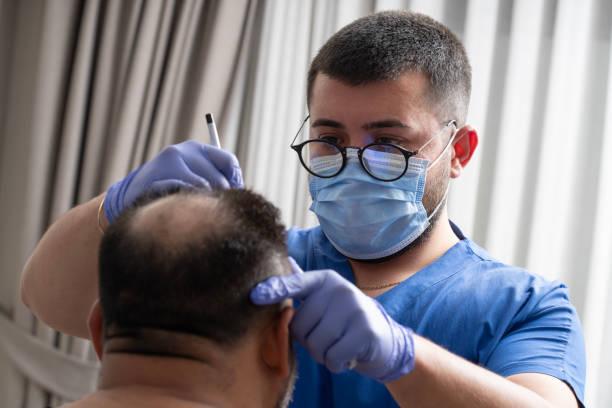
The crown can be one of the most challenging areas to restore because hair grows in a circular pattern around a central point called the whorl. Crown Hair Transplant in Dubai involves relocating healthy hair follicles into thinning or bald areas of the crown, with graft placement designed to follow the patient's natural growth direction. The aim is to improve coverage while preserving a realistic swirl, suitable density, and harmony with the rest of the scalp.
For many patients, crown thinning becomes noticeable under bright lighting, in overhead photographs, or when the hair is wet. Dubai's strong sunlight and indoor lighting can make reduced coverage more apparent, but successful restoration depends on the scalp's anatomy, donor-hair availability, and the likely progression of hair loss.
How Crown Hair Transplant Planning Accounts for Dubai's Environment
Dubai's climate does not change the fundamental mechanics of hair transplantation, but it can influence recovery planning and everyday scalp care. High temperatures, intense UV exposure, humidity during summer, and prolonged indoor air conditioning all affect how patients manage their scalp after surgery.
The most important consideration is protecting the healing recipient area while following the surgeon's instructions. Direct sunlight, excessive sweating, and premature friction can interfere with comfortable recovery, particularly during the early healing period.
Why the Crown Needs a Different Design
Unlike the frontal hairline, which generally follows a more predictable forward-facing direction, the crown often has a spiral or whorl. Hair angles change around this pattern, so graft placement must account for the direction in which individual hairs emerge from the scalp.
The crown also covers a relatively broad surface. Because transplanted follicles need to be distributed across the area, the surgeon must balance coverage, available donor grafts, and the patient's long-term hair-loss pattern.
Practical Considerations for Dubai Residents
Patients should plan their recovery around work, outdoor activities, and travel. The surgeon may recommend avoiding strenuous exercise, heavy sweating, swimming, and direct sun exposure for a specified period based on the technique and healing progress.
Air conditioning can make the scalp feel dry or tight, while humidity may increase discomfort for some patients. Neither condition determines transplant success on its own, but appropriate aftercare and gentle scalp hygiene remain important.
Crown Hair Transplant Compared With Other Hair Restoration Options
A crown transplant is not the only option for people experiencing thinning at the back of the scalp. The right approach depends on whether follicles are miniaturizing, whether the area has become bald, and how much donor hair is available.
| Treatment | Main purpose | Important consideration |
|---|---|---|
| Crown hair transplant | Relocates follicles into thinning or bald areas | Requires suitable donor hair and careful graft placement |
| Medical hair-loss treatment | Helps manage certain causes of ongoing hair loss | Suitability depends on diagnosis and medical history |
| PRP treatment | Uses a platelet concentrate derived from the patient's blood | Response varies, and it does not replace missing follicles |
| Regenerative hair therapy | Aims to support the follicular environment, depending on the protocol | Evidence and methods differ between treatments |
| Scalp micropigmentation | Creates the appearance of greater density using pigment | Does not grow hair or restore follicles |
These treatments serve different purposes. Medical management may help control ongoing hair loss, while transplantation physically moves follicles into the recipient area.
Why a Crown Transplant May Require Careful Graft Allocation
Patients sometimes assume that the crown needs the same density as the frontal hairline. In practice, the crown's circular growth pattern and broad surface area can make graft distribution more complex.
A surgeon must consider the visual effect of the whorl, the characteristics of the donor hair, and the possibility that native hair may continue thinning. Concentrating too many grafts in one region may limit the donor supply available for other areas later.
Clinical Technique and Graft Placement for Crown Restoration
A crown transplant begins with a detailed assessment of the scalp, donor region, hair calibre, and pattern of loss. The surgeon evaluates the whorl and determines how grafts should be placed to reproduce the natural direction and distribution of existing hair.
For patients exploring Crown Hair Transplant in Dubai, the treatment plan should account for both the visible thinning today and the possibility of future hair loss. More information about the procedure is available on the Crown Hair Transplant in Dubai service page.
Donor Assessment and Graft Selection
The donor area is usually assessed at the back and sides of the scalp, where follicles may be less susceptible to common pattern hair loss. However, donor suitability varies, and not every patient has enough usable follicles to achieve the density they expect.
The surgeon considers the number of grafts available, the thickness and characteristics of the hair, and the size of the crown area. These factors help establish a realistic plan rather than promising uniform density regardless of the starting conditions.
Why Direction and Angle Matter
The crown's whorl is a three-dimensional pattern, not simply a circular patch of thinning. Grafts must be placed at suitable angles and directions to blend with surrounding hair and avoid an artificial appearance.
The recipient sites also need to be designed with care because the angle at which a hair emerges influences how it lies and how much scalp remains visible between strands.
What Happens During the Procedure
Depending on the selected surgical technique, follicular units may be extracted individually or prepared from a donor strip. The selected grafts are then placed into carefully planned recipient sites in the crown.
The procedure's duration, graft count, anaesthesia, and aftercare depend on the individual treatment plan. These details should be discussed with the treating surgeon before the procedure.
Real Patient Concerns and Clinical Realities
Patients often arrive with assumptions about crown restoration that deserve a clear explanation. Three common concerns are particularly important when setting expectations.
“Will the crown look completely dense after one procedure?”
Not necessarily. The crown covers a broad area, and the final appearance depends on graft availability, hair characteristics, scalp coverage, and the growth pattern. A surgeon should explain the likely result based on the patient's anatomy rather than promise a fixed density.
“If I transplant the crown, will my hair loss stop?”
A transplant moves follicles; it does not automatically stop the underlying process of pattern hair loss. Native hair may continue to thin, so long-term management and follow-up can remain important.
“Why does the crown sometimes look thinner while it is healing?”
Transplanted hair commonly sheds during the early post-operative period before new growth develops. Visible improvement takes time, and temporary changes in appearance do not by themselves establish whether the final result will be successful.
Natural Results Depend on More Than Graft Numbers
The total number of grafts is only one part of the plan. The direction of growth, donor-hair characteristics, crown size, and the distribution of follicles all influence the final appearance.
Patients should also understand that transplanted hair generally follows its own growth cycle. The outcome develops gradually rather than appearing immediately after surgery.
Crown Hair Transplant Treatment Roadmap and Timeline
The following roadmap outlines the general stages of surgical crown restoration. Exact timings and instructions vary between patients and techniques.
- Initial consultation and diagnosis. The surgeon reviews the pattern of hair loss, medical history, scalp condition, and treatment goals. Where appropriate, further assessment may be recommended before surgery.
- Donor-area evaluation and planning. The clinician estimates the available graft supply and maps the crown's whorl, recipient area, and intended distribution.
- Procedure day. The selected donor-hair harvesting method is performed, followed by preparation and placement of follicular grafts into the planned recipient sites.
- Early recovery. The scalp may have temporary redness, swelling, tenderness, or small crusts. Patients follow the clinic's instructions for washing, sleeping, activity, and protecting the recipient area.
- Temporary shedding and gradual regrowth. Transplanted hair can shed before new growth emerges. This is a common part of the hair-transplant cycle, although the timing varies.
- Progress reviews. Follow-up appointments allow the clinical team to review healing and assess changes in growth and coverage.
- Longer-term outcome assessment. Crown results develop over several months, and maturation can take around 12 months or sometimes longer. The surgeon should explain the expected timeline for the individual's procedure.
Planning Around Work and International Travel
Patients travelling to Dubai for treatment should allow enough time for initial recovery and any recommended follow-up. Flying, returning to work, or resuming exercise should be discussed with the treating team according to the procedure and the patient's progress.
Avoid scheduling strenuous outdoor activities immediately after surgery. In Dubai's climate, sun protection and activity planning are especially relevant while the scalp is healing.
Long-Term Hair Health After Crown Restoration
A crown transplant should be planned with the future in mind. Hair loss may continue in untreated areas, and the donor supply is finite, so a balanced strategy is more useful than focusing exclusively on the area that looks thinnest today.
Long-term care may include monitoring changes in native hair, following medically appropriate hair-loss management, and attending recommended reviews. A healthy scalp supports good care, but no routine can guarantee a particular transplant outcome.
For patients considering crown restoration, Tajmeels Clinic provides a starting point for learning about the clinic and arranging a consultation to discuss individual hair-restoration goals.
The most appropriate plan depends on the patient's scalp anatomy, donor capacity, pattern of hair loss, and expectations. With careful assessment and realistic planning, crown restoration can aim to improve coverage while preserving a natural-looking growth pattern.
 Deutsch
 English
 Arabic
 French
 Spanish
 Portuguese
 Turkish
 Dutch
Dutch
 Italiano
 Russian
 Romaian
 Portuguese (Brazil)
 Greek
Greek