


AI Agent Builder vs Traditional Automation: What's Different
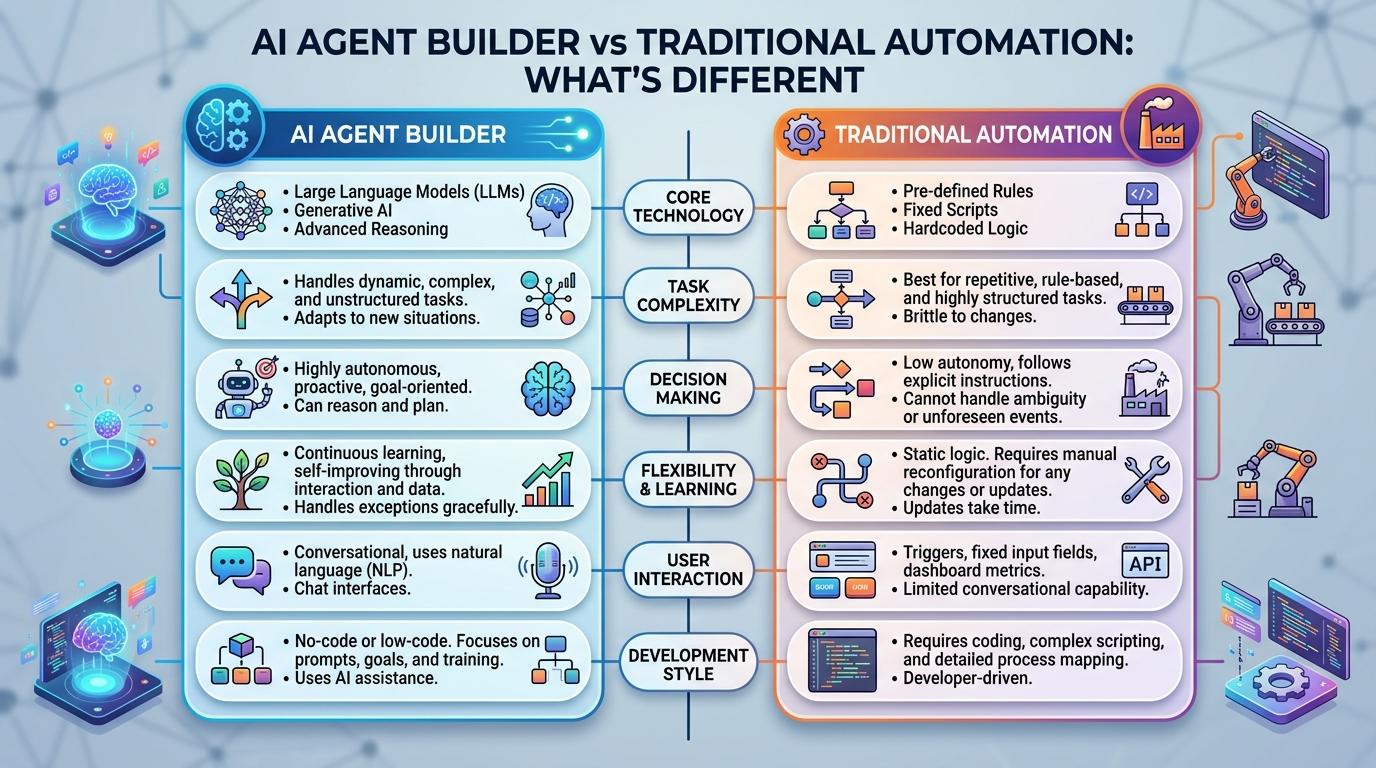
Businesses have used traditional automation tools for years to handle repetitive tasks, and it is fair to ask what genuinely distinguishes an AI agent builder from these more established solutions. The difference matters practically, since choosing the wrong approach for a given task wastes time and often produces a worse result than simply picking the tool actually suited to the problem. This guide compares both approaches honestly and helps clarify when each one genuinely fits.
How Traditional Automation Works
Traditional automation tools follow a fixed, predetermined sequence of steps every time they run. A workflow automation might trigger when a form is submitted, then always perform the exact same sequence of actions in the exact same order, regardless of what specific content appears in that particular submission. This predictability is traditional automation's core strength: behavior is fully deterministic, testable in advance, and reliable precisely because it never deviates from its programmed path.
How an AI Agent Builder Changes This
An AI agent builder introduces a fundamentally different capability: the agent can interpret a goal, decide what steps are needed based on the specific situation it encounters, and adjust its approach dynamically rather than following one fixed path regardless of circumstances. This flexibility allows agents to handle variation and ambiguity that would break a traditional automation built around fixed logic, but it also introduces less predictability, since an agent's exact behavior in every possible scenario cannot always be fully anticipated in advance the way a traditional automation's behavior can.
When Traditional Automation Genuinely Wins
For tasks with a truly fixed, well understood process and little genuine variation, traditional automation typically remains the better choice. A workflow that always performs the identical sequence of steps regardless of input specifics, such as automatically creating a calendar event whenever a specific type of email arrives, does not benefit from an agent's dynamic decision making capability, and the added complexity of an AI agent builder offers no genuine advantage here. Traditional automation is also generally more cost effective and more predictable for these well defined, unchanging tasks.
When an Agent Genuinely Adds Value
Agents built through an AI agent builder earn their additional complexity specifically when a task involves genuine variation, judgment calls, or the need to synthesize information from multiple sources before deciding on an appropriate action. A customer support scenario where inquiries vary enormously in phrasing, context and required response benefits from an agent's ability to interpret intent and adapt its approach, something a fixed traditional automation workflow struggles to handle without an impractically large number of hardcoded rules attempting to anticipate every possible variation.
The Hybrid Reality Most Teams Actually Use
In practice, many effective implementations combine both approaches rather than choosing one exclusively. A well designed system might use traditional automation for the genuinely fixed, predictable portions of a broader process, while using an AI agent builder specifically for the portions requiring judgment or handling genuine variation. This hybrid approach captures traditional automation's reliability and cost efficiency for suitable tasks while reserving agent capability specifically for the parts of a process that genuinely benefit from it.
Cost and Complexity Tradeoffs
Traditional automation generally costs less to build and maintain for suitable, well defined tasks, since its fixed logic is simpler to test exhaustively and does not carry the ongoing cost of AI model usage that agents typically involve. An AI agent builder project, while more capable of handling variation, typically costs more both to build initially and to run ongoing, given AI model usage costs and the additional testing rigor needed to gain confidence in an agent's behavior across varied scenarios.
Making the Right Choice for a Specific Task
The clearest way to decide between these approaches is asking honestly whether a task's process is genuinely fixed and well understood, in which case traditional automation likely suits it well, or whether the task involves meaningful variation, ambiguity or judgment calls that a fixed workflow would struggle to handle without excessive complexity, in which case an AI agent builder likely delivers better results despite its additional cost and complexity.
Final Thought
An AI agent builder and traditional automation solve genuinely different categories of problems rather than one simply being an upgraded version of the other. Traditional automation remains the better, more cost effective choice for genuinely fixed, predictable processes, while agent based approaches earn their additional complexity specifically for tasks involving real variation and judgment. Many effective systems ultimately combine both, using each approach where it genuinely fits rather than forcing every task through a single tool regardless of its actual nature.
 Dutch
Dutch
 English
 Arabic
 French
 Spanish
 Portuguese
 Deutsch
 Turkish
 Italiano
 Russian
 Romaian
 Portuguese (Brazil)
 Greek
Greek