


Why Is Dabba Trading Still Popular? Understanding Its Risks and Reality
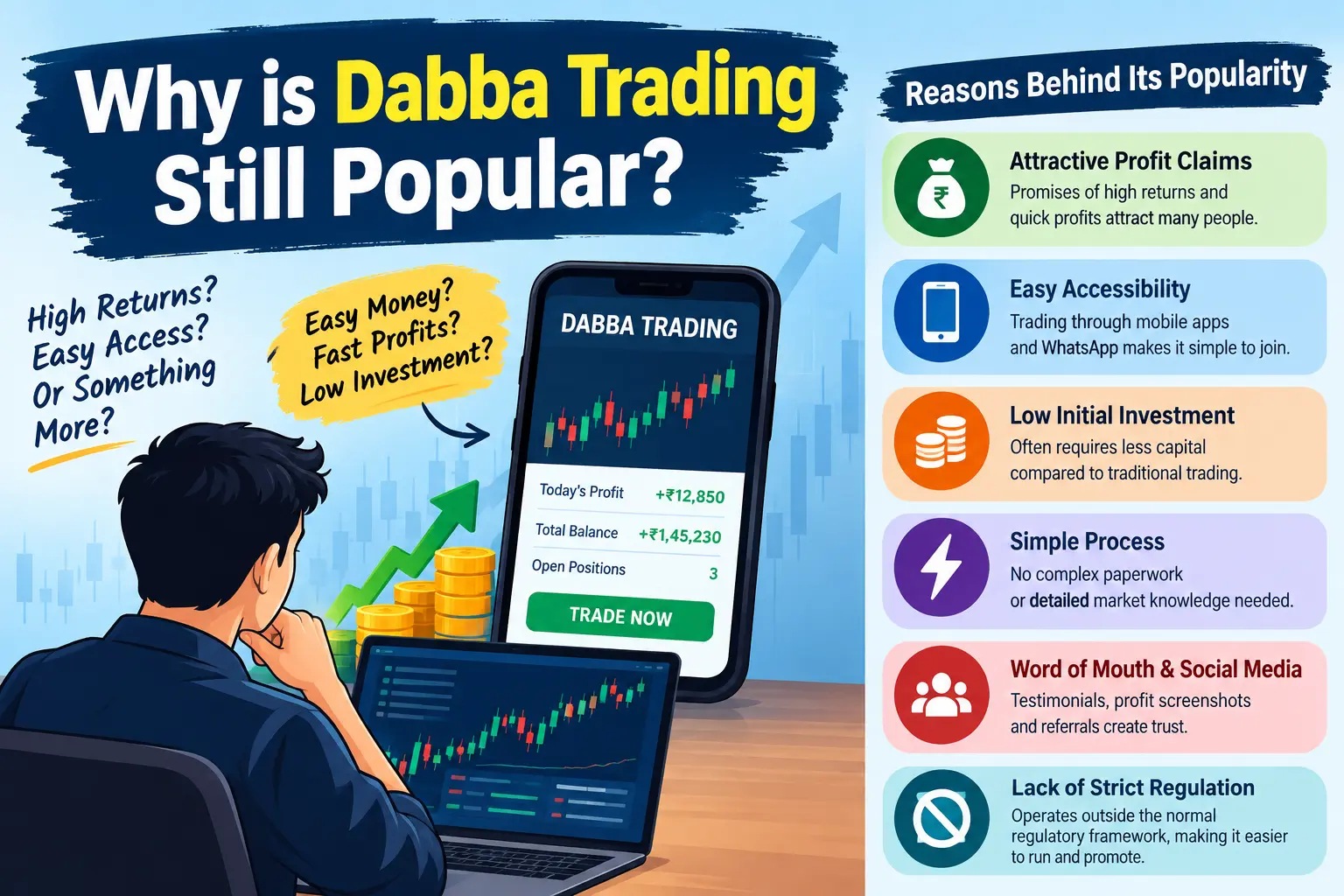
Dabba trading continues to attract attention in India despite being illegal and carrying significant financial and legal risks. The practice has existed for decades, adapting to changes in technology, communication, and investor behavior. For some participants, the appeal lies in the promise of quick profits, low entry barriers, and the perception of greater flexibility than traditional stock-market trading.
But behind this apparent convenience is a system that operates outside the regulated securities market. Understanding why dabba trading remains popular—and what participants actually risk—is essential for anyone considering it.
What Is Dabba Trading?
Dabba trading is an unofficial form of trading in which transactions are settled privately between the trader and the client rather than being executed through a recognized stock exchange.
The term "dabba" broadly refers to an off-market or unofficial system. A customer may place an order with a dabba operator based on the price movements of stocks, indices, commodities, or other market instruments. However, the trade itself is not necessarily executed on a recognized exchange.
Instead, the operator maintains an internal record of the customer's positions and settles profits or losses directly.
This distinction is important. In regulated markets, trades are conducted through recognized exchanges and intermediaries operating under established rules and investor-protection mechanisms. Dabba trading bypasses that framework.
Why Does Dabba Trading Remain Popular?
Several factors help explain its continued appeal.
1. The Promise of Quick Profits
Dabba trading is often promoted as a way to make money from short-term market movements. Operators may emphasize the possibility of substantial returns from relatively small amounts of capital.
This can be particularly attractive to people interested in intraday trading or speculation. However, the possibility of rapid gains also comes with the possibility of rapid and substantial losses.
2. Low Perceived Entry Barriers
Traditional securities trading involves opening a regulated trading and demat account and completing the applicable onboarding and compliance requirements.
Dabba operators may instead offer informal arrangements that appear simpler to prospective customers. The absence of formal procedures can make the activity seem accessible, especially to inexperienced traders.
That apparent simplicity should not be confused with safety.
3. Aggressive Word-of-Mouth Promotion
Dabba trading networks can spread through personal contacts, local communities, messaging platforms, and informal financial networks.
A person may hear about an operator from someone who claims to have made money through the system. Such personal recommendations can create a perception that the activity is trustworthy, even though individual success stories do not establish that the underlying system is safe or legitimate.
4. The Attraction of Leverage
Some dabba arrangements may offer customers the ability to take positions much larger than their available funds.
Leverage can magnify gains, but it also magnifies losses. A relatively small adverse movement in the underlying market can therefore create a substantial financial obligation for the participant.
5. Misunderstanding of the Risks
Some newcomers may not fully understand the difference between trading through a regulated intermediary and placing bets on market movements through an unregulated operator.
The interface may look similar to ordinary trading, and operators may use familiar market terminology. But the legal and financial structure can be fundamentally different.
Read More Article:-
Dabba Trading Online in Hyderabad
Dabba Trading Online in Gujarat
Dabba Trading Online in Karnataka
Dabba Trading Online in Punjab
Dabba Trading Online in Kolkata
Dabba Trading Online in Tamil Nadu
Dabba Trading Online in Nagpur
Dabba Trading Online in Maharashtra
Best Dabba Trading App in India
What is Dabba trading? How it Works
Dabba Trading vs Intraday Trading
The Biggest Risk: There May Be No Actual Exchange Trade
One of the most important realities of dabba trading is that the customer's transaction may never reach a recognized stock exchange.
Instead, the operator may simply record the customer's position internally.
For example, suppose a customer takes a position based on an index moving from 20,000 to 20,100. The operator may calculate the customer's profit or loss using that movement without an exchange trade being placed in the customer's name.
This creates a fundamentally different risk structure.
In a regulated market, transactions are supported by established infrastructure, records, rules, intermediaries, clearing mechanisms, and regulatory oversight. In an informal arrangement, the participant may be relying primarily on the operator's records and willingness to honor the settlement.
Counterparty Risk Can Be Significant
Imagine that a trader makes a large profit according to the operator's records.
The trader may expect to receive that money from the operator. But because the arrangement is outside the normal regulated trading and settlement framework, recovering the money can become difficult if the operator refuses to pay, disappears, or becomes unable to meet its obligations.
The risk is therefore not limited to whether the market moves in the trader's favor.
The participant also faces the risk that the counterparty itself will not honor the arrangement.
There Is No Guaranteed Investor Protection
One of the major differences between regulated securities trading and dabba trading is the regulatory framework surrounding recognized market transactions.
Regulated market participants operate within rules covering areas such as intermediary registration, trading practices, disclosures, surveillance, and investor grievance mechanisms.
An individual dealing with an unauthorized operator should not assume that the same protections apply.
This means that a participant who encounters a dispute may face significant difficulty in recovering funds or establishing the exact terms of the transaction.
Legal Risk
Dabba trading is not simply an alternative way of accessing the stock market.
It can involve violations of securities-market laws and regulations, and authorities in India have repeatedly taken enforcement action against entities involved in unauthorized trading activities.
The legal consequences can vary depending on the specific conduct involved. Participants should therefore not assume that only the operator faces consequences.
Anyone considering such an arrangement should verify whether the intermediary is authorized to provide the relevant financial service.
Fraud Risk
The informal nature of dabba trading can also create opportunities for fraud.
A dishonest operator could:
-
Manipulate internal records.
-
Delay or refuse withdrawals.
-
Change settlement calculations.
-
Demand additional money after losses.
-
Disappear after collecting funds.
-
Use misleading claims about profits or trading performance.
Because transactions may not exist in the normal exchange records, proving what actually happened can become difficult.
Why Experienced Traders Can Also Get Caught
Dabba trading is not necessarily limited to beginners.
Experienced market participants can also be attracted by promises of lower costs, high leverage, or fast execution. Familiarity with financial markets, however, does not eliminate counterparty or legal risks.
Knowing how to analyze a stock or index is very different from assessing the reliability of an unauthorized trading arrangement.
A trader can correctly predict the market and still lose money if the counterparty fails to settle.
Technology Has Changed the Way Dabba Trading Operates
Dabba trading has evolved alongside digital communication.
In the past, informal trading networks could depend heavily on face-to-face relationships and telephone communication. Today, operators can potentially communicate with customers through messaging applications, websites, social-media accounts, and other digital channels.
Technology can make these arrangements appear more sophisticated.
A website, mobile interface, or digital statement, however, does not automatically mean that a trading platform is regulated or that transactions are being executed on a recognized exchange.
The regulatory status of the intermediary matters more than the appearance of the technology.
Dabba Trading vs. Regulated Trading
The difference can be summarized simply:
|
Factor |
Regulated Trading |
Dabba Trading |
|
Exchange participation |
Transactions are executed through recognized market infrastructure |
Transactions may be recorded privately |
|
Regulatory oversight |
Subject to applicable securities-market regulation |
Outside the normal regulated framework |
|
Investor protection |
Regulatory mechanisms may apply |
Protections may be limited or unavailable |
|
Counterparty risk |
Structured clearing and settlement mechanisms |
Direct dependence on the operator |
|
Transparency |
Established records and reporting mechanisms |
Internal records may be controlled by the operator |
|
Legal status |
Permitted when conducted through authorized channels |
Unauthorized dabba trading is illegal |
|
Dispute resolution |
Established regulatory and market mechanisms may be available |
Recovery can be considerably more difficult |
The Reality Behind "Easy Money"
The biggest misconception surrounding dabba trading is that it is simply a faster version of ordinary trading.
It is not.
The potential financial outcome depends not only on the market movement but also on the operator, the settlement arrangement, the accuracy of internal records, and the willingness and ability of the counterparty to pay.
A system that appears to reduce paperwork may actually shift more risk onto the customer.
What Should Investors Do Instead?
People interested in participating in India's securities markets can use regulated channels.
Before opening an account or transferring money, investors should verify the status of the intermediary through the relevant regulatory resources and understand what products and services they are authorized to provide.
Investors should also be cautious about claims such as:
-
"Guaranteed returns"
-
"No-loss trading"
-
"Fixed daily income"
-
"Unlimited leverage"
-
"Special insider calls"
-
"Guaranteed withdrawal"
-
"Double your money quickly"
Promises of easy and guaranteed profits deserve particular scrutiny.
Final Thoughts
Dabba trading remains attractive because it can appear simple, flexible, and profitable. Its informal nature, aggressive word-of-mouth promotion, perceived low barriers to entry, and attraction of leverage can continue to draw participants.
But the apparent advantages come with substantial risks.
The central issue is that participants may be operating outside the protections and infrastructure of the regulated securities market. They can face market losses, counterparty failure, fraud, and legal consequences.
For anyone interested in trading, understanding who is executing the transaction, whether the intermediary is authorized, where the trade is being executed, and what investor protections apply is far more important than promises of quick profits.
In financial markets, convenience should never be mistaken for security—and the possibility of high returns should always be considered alongside the possibility of losing the money involved.
 Turkish
 English
 Arabic
 French
 Spanish
 Portuguese
 Deutsch
 Dutch
Dutch
 Italiano
 Russian
 Romaian
 Portuguese (Brazil)
 Greek
Greek