


How Much Landscaping Rock Do You Need for Your Project
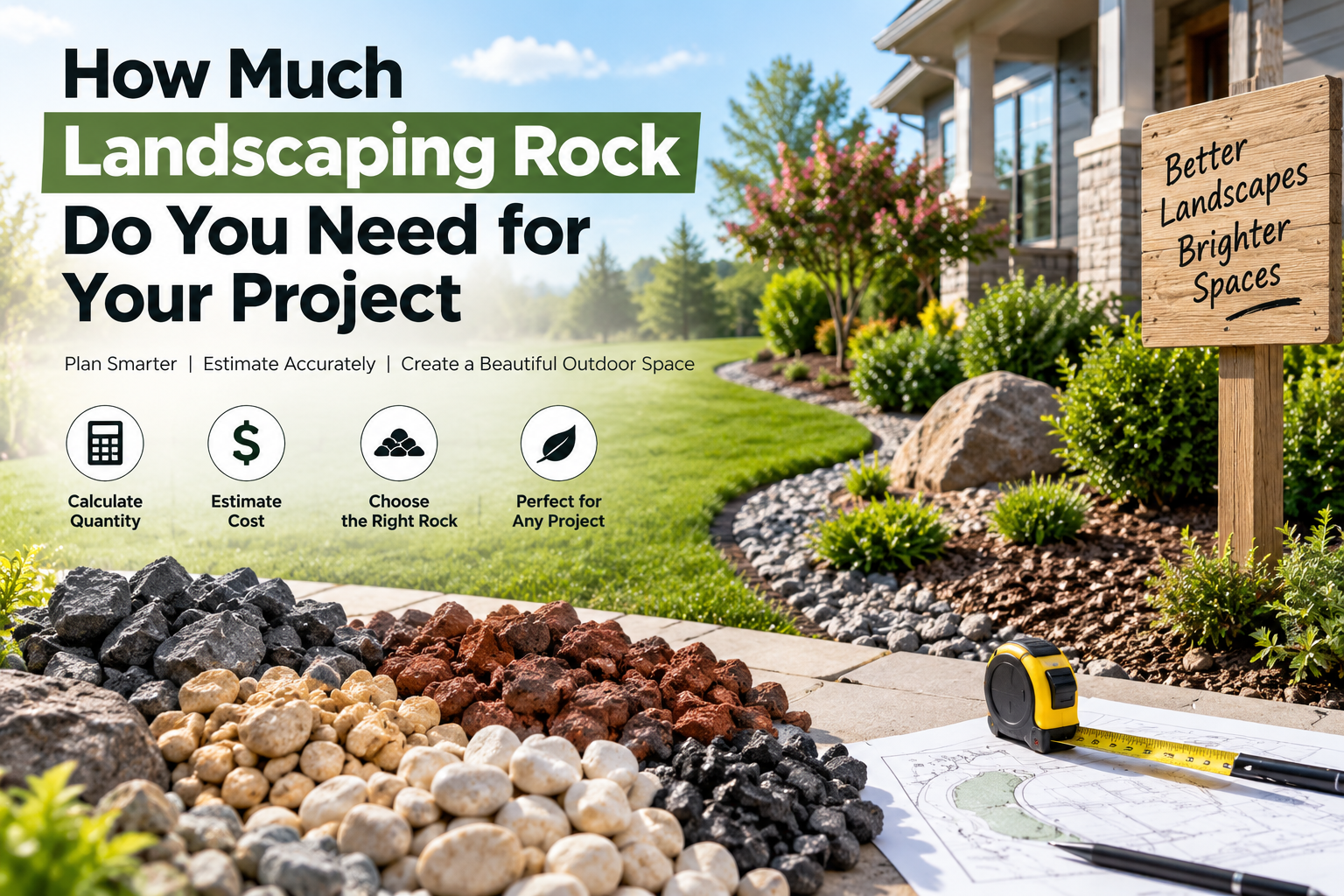
I learned the hard way that landscaping rock is not something you can eyeball. My first attempt at a rock garden border left me two trips to the supply yard short, and by the third trip the guy at the counter already knew my name.
If you're planning a rock feature, a dry creek bed, or just want to swap out mulch for stone, getting the amount right up front saves you time, money, and a lot of frustrating extra drives. Here's how to actually figure it out.
Why Getting the Amount Right Actually Matters
Landscaping rock isn't cheap once you add up delivery fees and bulk pricing. Ordering too little means paying for a second delivery, and ordering too much means stone sitting in your driveway for months.
There's also a weight factor most people don't think about. Rock is heavy, and if you're hauling it yourself in a trailer or truck bed, knowing the volume ahead of time keeps you from overloading your vehicle.
Getting close on the first order also just makes the project less stressful. You want to be focused on placing the stone, not doing math in your head while standing in a gravel yard.
Start With the Area You're Covering
The first step is measuring the space. For a square or rectangular area, multiply the length by the width to get your square footage.
If your bed is 10 feet by 6 feet, that's 60 square feet. For odd shapes, break the space into smaller rectangles or circles, measure each one, then add the totals together.
Don't skip this step even if the area looks simple. A lot of people guess the square footage and end up way off, especially with curved beds or borders that aren't perfectly straight.
Then Factor in Depth
This is the part people miss most often. Depth changes your total volume more than most people expect.
A thin decorative layer might only need 1 to 2 inches of rock. A functional layer meant to suppress weeds usually needs 2 to 3 inches. Larger rock used for drainage or erosion control often needs 4 inches or more.
The deeper the layer, the more material you need, and the jump between 2 inches and 4 inches is bigger than it sounds once you're covering a large area.
The Basic Formula
Once you have square footage and depth, the math looks like this. Multiply square footage by depth in feet, which gives you cubic feet. Divide that number by 27 to convert to cubic yards, since most suppliers sell rock by the yard.
So for our 60 square foot bed with a 3 inch layer, you'd convert 3 inches to 0.25 feet, multiply by 60 to get 15 cubic feet, then divide by 27. That comes out to a little over half a cubic yard.
It's simple once you've done it a few times, but it's easy to mess up the unit conversions if you're doing it manually, especially converting inches to feet.
Rock Type Changes the Numbers Too
Not all landscaping rock covers the same. Smaller stones like pea gravel settle tighter and cover more area per yard. Larger decorative rock leaves more gaps and covers less per yard for the same depth.
If you're mixing rock sizes or using a border stone around a smaller decorative rock, you'll want to calculate each section separately rather than treating the whole project as one uniform layer.
This is also where weight comes into play again. Larger rock is heavier per cubic yard, which matters if you're arranging delivery or hauling material yourself.
A Shortcut Worth Using
Doing this math by hand works fine for a single small bed, but it gets tedious fast once you're covering multiple areas or dealing with different rock types and depths.
I started running my numbers through a landscaping rock calculator instead of doing it manually every time, and it cut out most of the guesswork. You just enter your measurements and depth, and it gives you the yardage right away.
It's a small tool, but it's saved me from both over-ordering and under-ordering more than once, especially on bigger projects with multiple zones.
Baaki poora article same rahega, sirf yeh paragraph replace kar dena jahan link add hua hai.
Common Mistakes to Watch For
A few mistakes come up again and again with rock projects.
The first is forgetting to account for edging or borders that eat into the coverage area. The second is assuming all rock types cover the same, which isn't true once you compare pea gravel to larger decorative stone. The third is skipping a buffer amount for settling, since rock does compact somewhat over the first few weeks.
Adding a small buffer, usually around 10 percent extra, is a smart habit for any rock project.
Quick Reference
Here's a simple way to estimate coverage per cubic yard at different depths:
At 1 inch deep, one cubic yard covers about 324 square feet.
At 2 inches deep, one cubic yard covers about 162 square feet.
At 3 inches deep, one cubic yard covers about 108 square feet.
At 4 inches deep, one cubic yard covers about 81 square feet.
These numbers assume standard rock and give you a solid starting point before you fine tune for your specific material.
Final Thoughts
Landscaping rock projects go a lot smoother when you measure first and order second. A few minutes with a tape measure and some basic math can save you an extra trip to the supply yard and keep your budget on track.
If your project has multiple beds or mixed rock sizes, take it section by section rather than estimating the whole yard at once. It's a small extra step that makes a real difference once the rock actually gets delivered.
 Deutsch
 English
 Arabic
 French
 Spanish
 Portuguese
 Turkish
 Dutch
Dutch
 Italiano
 Russian
 Romaian
 Portuguese (Brazil)
 Greek
Greek