


Warning Signs Your Haulage Business Has Outgrown Its Current Setup
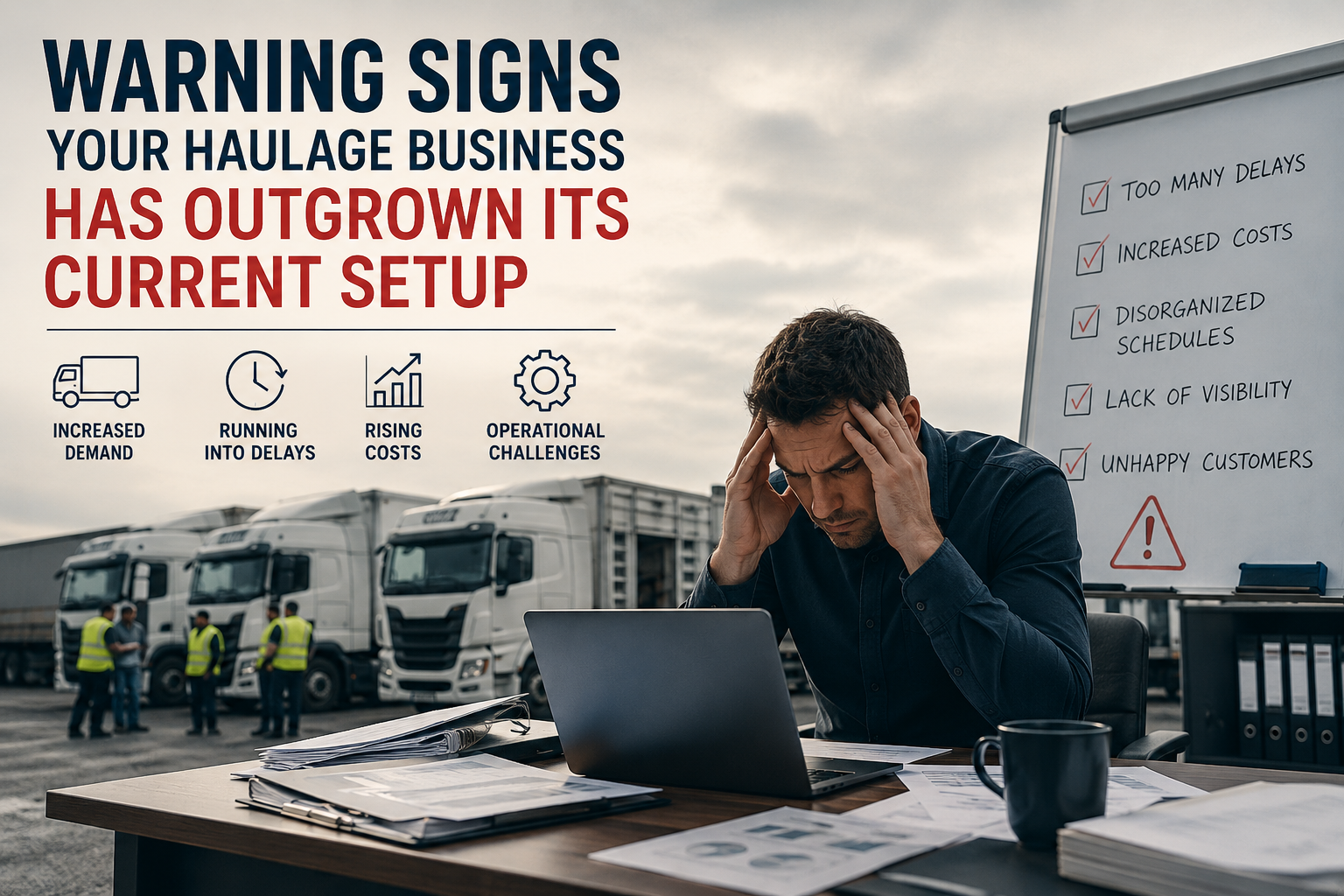
Growth rarely announces itself neatly. More often it shows up as a run of missed delivery windows, a vehicle off the road at the worst moment, or a sales team promising next-day delivery your fleet cannot reliably provide.
Arrangements that worked comfortably at one volume start to strain at another. Two vans and a flexible driver can serve a business shipping a handful of pallets weekly. Triple that volume, add timed deliveries and customers across three regions, and the same setup becomes a bottleneck.
The change is gradual, which is the difficulty. Costs creep, delays become normal, and the drag gets absorbed rather than addressed. This article sets out the warning signs and how to judge whether expanding your fleet or working with a haulage partner makes better sense.
What Does It Mean to Outgrow Your Haulage Setup?
Outgrowing a transport setup means your delivery capability has become a constraint on the business rather than a support to it.
The signs are practical. You turn down work because you cannot deliver it. You quote longer lead times than competitors. Vehicles run full one way and empty back. Someone spends hours each week chasing deliveries instead of doing their actual job.
None of this means the original arrangement was wrong. A setup sized for a smaller operation was probably right at the time. The question is whether it still fits the business you run now.
1. Your Delivery Volumes Are Becoming Difficult to Manage
Rising pallet volumes are the clearest signal. When consignments get held over to the following day for lack of space on a vehicle, capacity has become the limiting factor.
Seasonal peaks expose this fastest. A business handling steady volumes most of the year may face triple that in a busy quarter, and buying vehicles for a peak lasting eight weeks is expensive for the remaining forty-four.
Scalable road haulage services work differently. Capacity flexes with volume, so you pay for what you move rather than maintaining assets sized for your busiest week.
2. Your Fleet Is Constantly at Capacity
A fleet running at maximum utilisation sounds efficient. In practice it removes all resilience.
With every vehicle committed, one breakdown or driver absence disrupts multiple customers. Urgent consignments cannot be accommodated, and maintenance gets deferred because taking a vehicle off the road is impossible, which raises the eventual repair bill.
Adding a vehicle is a substantial commitment: purchase or lease, insurance, maintenance, tax and a driver. That makes sense with consistent volume to fill it. Where demand fluctuates, outsourcing the peaks while keeping core work in-house is often more economical.
3. Delivery Delays Are Becoming More Common
Occasional delays are unavoidable. A pattern of them is a different matter.
Late deliveries damage more than the individual order. Retail customers work to booking slots, and missing one can mean rejection at the door plus a return journey. Manufacturing customers holding minimal stock may halt a line. Repeat business quietly disappears, and sector reputations travel faster than most businesses expect.
Established networks improve reliability through scale. Multiple vehicles cover each region daily, so one vehicle problem does not automatically become a customer problem.
4. Your Transport Costs Keep Rising
Fuel is the visible cost. It is rarely the largest.
Running your own vehicles also means maintenance and MOT, insurance, driver wages and training, licensing and compliance, depreciation, and the administrative time managing all of it. Empty running adds another hidden cost, since a vehicle returning empty earns nothing while still consuming fuel and driver hours.
Compare total cost per pallet delivered rather than headline rates, including fleet overheads, utilisation and administration. Businesses making this comparison properly are often surprised at what in-house delivery actually costs.
5. You Are Spending Too Much Time Managing Deliveries
Transport administration expands quietly: booking collections, planning routes, tracking consignments, scheduling drivers, chasing paperwork, handling failed deliveries, updating customers.
At low volumes this fits around other work. At higher volumes it becomes a role, usually performed by someone whose actual job is sales, operations or customer service.
Specialist providers absorb it. Booking, tracking, proof of delivery and exception handling sit with the operator, leaving your team on work that generates revenue.
6. You Cannot Easily Scale During Busy Periods
Sudden volume comes from several directions: seasonal peaks, promotional activity, a large new contract, or a competitor's supply problems sending customers your way.
Each needs capacity you may not have. Recruiting drivers takes time and vehicles cannot be acquired overnight, so turning down a significant order on delivery constraints becomes a real risk.
A wider network provides elasticity a small internal fleet cannot. Shared infrastructure means capacity is there when you need it and costs nothing when you do not.
7. Your Customers Are Asking for More Delivery Options
Customer expectations have shifted considerably. Businesses now routinely ask for next-day delivery, timed morning or afternoon slots, booked-in deliveries for retail distribution centres, weekend or evening options, and full or part-load flexibility depending on consignment size.
They also expect visibility. Tracking and electronic proof of delivery have become standard rather than premium.
Pallet distribution networks such as Palletline are built around exactly these requirements. Because volume is consolidated across many customers, service options that would be uneconomic for a single business become viable.
8. You Are Struggling to Serve Customers Outside Your Local Area
Geographic expansion creates transport problems that local operations never face. A delivery two hundred miles away ties up a vehicle and driver for a day, and returns empty unless you have backloading arranged.
This is where the combination matters. A local haulage company brings knowledge that national operators often lack: which industrial estates have access restrictions, which sites need booking in, where urban delivery windows apply. Network membership then extends that local service across the country.
For businesses sending goods into London specifically, the challenges compound. Congestion and clean air zone requirements, restricted delivery windows, and difficult access at many premises all apply. Palletline London operates within a network that includes a North London regional hub, giving businesses outside the capital a route into it without running their own vehicles through it.
9. Your Technology and Tracking Systems Are Outdated
If answering "where is my delivery?" means phoning a driver, your systems are behind what customers expect.
Modern operations run on real-time consignment tracking, electronic proof of delivery captured at handover, automated notifications, digital booking and service reporting.
The customer service benefit is obvious. The operational one is less so but equally valuable: data showing which routes underperform, where delays cluster and how service levels trend gives you something to manage rather than guess at.
10. Your Current Provider Cannot Keep Up With Your Growth
Sometimes the constraint is not your own fleet but the operator you already use.
Warning signs include vehicles unavailable when you need them, poor communication when problems occur, inflexibility around delivery requirements, repeated delays without explanation, coverage gaps in regions you now serve, tracking that falls short of what your customers expect, and reluctance to handle rising pallet volumes.
A provider suited to a smaller operation may simply lack the capacity or infrastructure for where your business has got to. That is not necessarily a failing on their part, but it is a reason to review the arrangement.
Should You Expand Your Own Fleet or Outsource Haulage?
There is no universal answer. The right choice depends on volume, consistency, geography and how central delivery is to your proposition.
| Factor | In-house fleet | Outsourced haulage |
|---|---|---|
| Control | Direct control of vehicles, drivers and scheduling | Control through service agreements and KPIs |
| Capital | Significant investment in vehicles | Minimal capital requirement |
| Cost structure | Largely fixed | Largely variable with volume |
| Scalability | Limited by fleet size | Flexes with demand |
| Coverage | Practical within a defined radius | National and international via networks |
| Compliance | Operator licence, tachographs, maintenance obligations | Managed by the provider |
| Branding | Liveried vehicles at customer sites | Generally not branded to you |
| Best suited to | Consistent volumes, defined areas, specialist handling | Variable volumes, wide geography, mixed service needs |
In-house works well where volumes are steady and predictable, routes are concentrated, goods need specialist handling or equipment, or delivery presence forms part of the customer relationship.
Outsourcing works well where volumes fluctuate, deliveries are geographically dispersed, customers want service options a small fleet cannot support, or capital is better deployed elsewhere in the business.
Many growing businesses run both, keeping regular local work in-house and using haulage partners for distance, peaks and specialist requirements. That hybrid model often gives better economics than committing fully to either.
How to Choose the Right Road Haulage Services
Work through these when comparing providers:
- Capacity and vehicle options, including tail lifts, moffetts and any specialist equipment you need
- Geographic coverage, both current and where you plan to sell
- Pallet network membership, which determines national reach and service options
- Delivery flexibility: timed, booked-in, weekend, part and full loads
- Tracking technology and whether it integrates with your systems
- Sector experience relevant to your goods and customers
- Compliance and accreditation, including operator licensing and safety standards
- Communication, particularly how exceptions are handled and who you contact
- Scalability, and how peaks are managed
- Transparent pricing, including surcharges, waiting time and failed delivery charges
- Proof of delivery format and how quickly it reaches you
Ask specifically what happens when something goes wrong. Any provider performs adequately on a straightforward delivery. The difference shows on the difficult ones.
How Palletline Can Support a Growing Business
Palletline launched in 1992 as the UK's first pallet distribution network, built on a hub-and-spoke model that has since developed into a multi-hub operation. It is wholly member-owned by independent transport companies, each covering defined postcode areas.
The network operates a central hub in Birmingham alongside regional hubs in Glasgow, Haydock, Coventry and North London, with roughly 96 member depots covering the UK and delivery available across a wide range of European countries.
Operationally, the model works like this: a local member collects your pallets and scans them into the system, they pass a quality check at the depot, travel to a hub for consolidation and sorting by destination, then move out to the member depot covering the delivery area for final delivery.
For a growing business, the practical advantages are:
- National coverage without national infrastructure, since your local member handles collection and the network handles the rest
- Volume flexibility, sending one pallet or fifty without renegotiating arrangements
- Shared efficiency, as consolidated volumes make timed and next-day options viable
- Consistent tracking across the whole journey
- A single local relationship, dealing with one depot rather than multiple carriers
Service options, coverage and pricing vary between members, so confirm specifics with the depot covering your area.
When Is It Time to Change Your Haulage Setup?
Review your arrangements if several of these apply:
- Consignments regularly held over for lack of capacity
- Delivery constraints influencing which orders you accept
- Vehicles consistently at full utilisation with no contingency
- Delays becoming a pattern rather than an exception
- Customers requesting options you cannot provide
- Significant staff time absorbed by transport administration
- Expansion into regions your fleet cannot serve economically
- Empty running on a material proportion of journeys
- Tracking that falls short of customer expectations
- Rising cost per pallet delivered
- A current provider struggling with your volumes
Three or four of these suggests a review. More than that suggests transport is already limiting the business.
Final Thoughts
Transport infrastructure should enable growth, not cap it. When capacity constraints start shaping commercial decisions, the setup has become the problem rather than the solution.
The answer is not automatically outsourcing, nor automatically buying more vehicles. It depends on volumes, geography, how predictable demand is, and where capital is best deployed. What matters is assessing it deliberately, using accurate figures for what current arrangements actually cost.
If several of these signs look familiar, work out your genuine cost per pallet delivered and compare it against what a haulage partner or network member would charge for the same work. That calculation usually clarifies the decision.
Frequently Asked Questions
How do I know if my business needs a larger haulage operation? Look for capacity constraints affecting commercial decisions: orders declined or delayed because of delivery limits, consignments regularly held over, or no contingency when a vehicle is off the road. Cost per pallet delivered rising while volumes grow is another reliable indicator.
When should a business consider outsourcing transport? Typically when volumes fluctuate enough that a fixed fleet is uneconomic, when deliveries spread beyond an efficient radius, when customers want service options a small fleet cannot support, or when transport administration is consuming disproportionate management time.
What are the benefits of using a local haulage company? Local operators bring knowledge that matters practically: site access, booking-in requirements, restricted delivery windows, and route conditions. They are usually more responsive on urgent work, and where they belong to a national network, you get local service with national reach.
How can pallet networks help growing businesses? They provide national coverage without national infrastructure. Consolidating volume across many customers makes next-day and timed deliveries economically viable, and you can vary pallet volumes freely without renegotiating arrangements.
What should I look for in road haulage services? Coverage matching where you sell, vehicle types suited to your goods, the delivery options your customers request, proper tracking and proof of delivery, transparent pricing including surcharges, and clear communication when problems arise.
Can Palletline help businesses manage increasing pallet volumes? The network model is designed for variable volumes, with members handling anything from single pallets to regular multi-pallet consignments through shared hub infrastructure. Discuss specific requirements with the member depot covering your area.
Is outsourcing haulage more cost-effective than running an in-house fleet? It depends on utilisation. Consistently full vehicles on regular routes can make in-house economical. Variable volumes, long distances or significant empty running usually favour outsourcing, since costs become variable rather than fixed. Compare total cost per pallet delivered rather than headline rates.
 Russian
 English
 Arabic
 French
 Spanish
 Portuguese
 Deutsch
 Turkish
 Dutch
Dutch
 Italiano
 Romaian
 Portuguese (Brazil)
 Greek
Greek