


How to Write a Business Research Assignment That Actually Makes Sense
Most students don't get stuck on the writing. They get stuck a step earlier, on one question: what am I actually supposed to find out?
You get a topic, a word count and a deadline. Every instinct says to open a blank page and start with the introduction. But an assignment built that way usually reads like a long summary of things the writer already knew. The strong ones start with a decision about what is worth investigating, and everything else follows from that.
Here's the process, including a few habits I don't see in most study guides.
1. Turn the brief into a problem you can investigate
Before you open Google Scholar, read the brief twice. The second time, circle only the verbs.
Analyse, evaluate, compare, investigate, discuss. They sound similar, but they ask for different work. "Analyse the effect of employee motivation on productivity" doesn't want a tour of motivation theories. It wants you to look at the link between two things and say what the evidence suggests about it.
If you're free to choose your own subject, start with a wide look before you narrow down. Browsing research topics on business can show you how a broad area like "employee wellbeing" gets sharpened into something testable. The goal isn't to borrow a topic. Once you've seen a few, close the list and write what you want to find out in your own words, in one plain sentence. That sentence becomes the spine of the assignment, and it saves you from writing 1,500 words that never quite connect to anything.
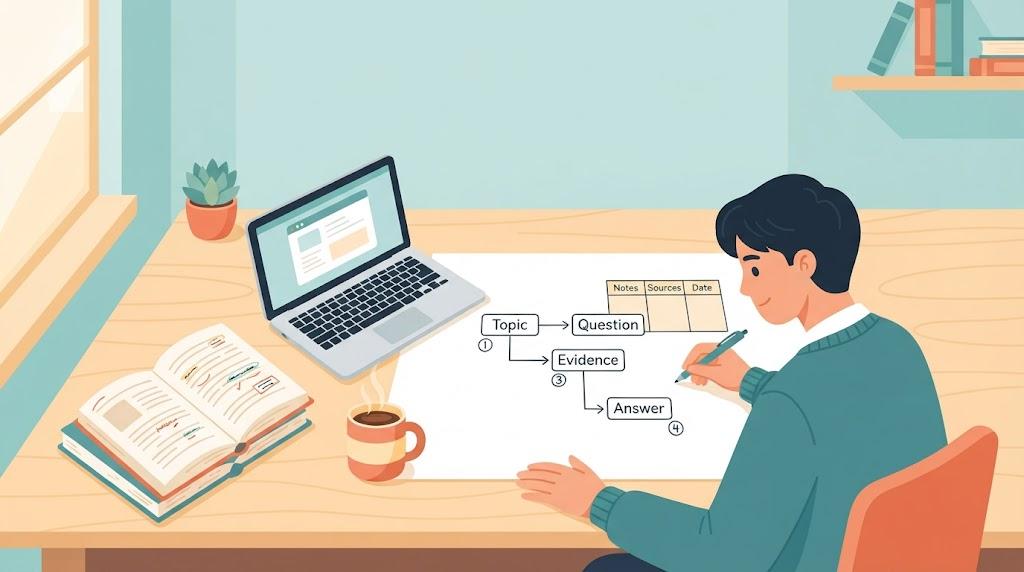
The chain to keep in your head:
Topic → problem → research question → evidence → argument
If you can't say what sits between "topic" and "evidence" in your own assignment, you're not ready to write yet.
2. Write a question, not a topic
"Social media marketing" is a topic. "How does influencer credibility affect consumer trust in beauty brands?" is a question.
A topic tells you which room you're standing in. A question tells you what you're looking for once you're inside.
Try this on your own draft. I call it the Monday Morning Test: imagine you're handed the question on Monday morning with only the word count you have. Could you realistically answer it with evidence by Friday? If you'd need a survey of 500 people or three years of company data, it's too big. Narrow it.
"Leadership in business" fails the test. "How does participative leadership affect employee engagement in small businesses?" passes. Now you know the concept, the outcome and the setting, and you know what to leave out.
3. Find the evidence first, then decide what you think
A lot of weak assignments are written backwards. The student picks an opinion, then goes looking for sources that agree with it. Markers can smell this from a mile away, because the sources feel like decoration.
Ask what kind of evidence your question needs. It might be peer-reviewed articles, company reports, government data, industry research, case studies or academic books. Then read with an open mind about where it leads.
Collecting ten papers on motivation isn't research. Summarising all ten isn't either. The value appears when you notice that six of them measured productivity by output per hour, three by manager ratings, and one by customer complaints, and that this might be why they disagree. Comparison is the moment research turns into analysis.
A tool worth trying: the disagreement map
Make three columns on a page: What they agree on, Where they split, Why they might split.
Fill it in as you read. Most students only ever fill in the first column. The third column is where marks live, because it's where you're doing thinking the sources didn't do for you. It usually points to industry differences, how a term was defined, sample size, or when the study was done.
4. Not every source deserves equal trust
Having information about your subject doesn't make a source useful. Before leaning on anything, ask:
- Who produced it, and why?
- What is the claim actually based on?
- How recent is it, and does recency matter here?
- What method was used?
- Does it apply to my question, or only something nearby?
- Is anyone finding the opposite?
Match the source to the claim. If you're describing market size, a recent industry report may be exactly right. If you're explaining why consumers behave a certain way, you probably want peer-reviewed behavioural research. Neither one replaces the other. Trouble starts when a market report is asked to explain human psychology, or a single case study is stretched to cover a whole industry.
5. Decide your answer before you write paragraph one
Once the reading is done, stop and write down, in two or three sentences, the answer you've been drifting towards. It can be messy. For example:
"Flexible working seems to improve satisfaction, but mostly where managers trust their teams and the work doesn't depend on being in the room."
That's already an argument, and it tells you what every paragraph is for. Each one gets a job:
- Explain the concept the reader needs.
- Bring in the evidence.
- Compare what different sources found.
- Explain why they differ.
- Tie it back to your question.
- State what the evidence lets you conclude, and what it doesn't.
Then test each paragraph with the So-What Check. Read it, and ask "so what?" out loud. If the honest answer is "nothing, it just repeats the last paragraph," cut it or merge it. A good paragraph moves the reader somewhere new.
6. Being critical doesn't mean being negative
Students often hear "be critical" and start attacking every author. That isn't what it means.
Critical analysis means comparing explanations, questioning assumptions, weighing evidence and being honest about limits. Say one study found remote working boosted productivity, and another found almost no change. Don't just pick the one that suits you. Ask why they might differ. Different industries? Different ways of measuring productivity? One study during lockdown and one long after?
Those questions turn "study A says X, study B says Y" into an actual discussion. That's usually the step that separates a solid mark from a strong one.
7. Let the conclusion answer the question
A conclusion isn't the introduction reworded. By the end, the reader has seen your evidence and your reasoning, so use the conclusion to answer the question you asked at the start.
If the evidence is mixed, say it's mixed. If one explanation is stronger but has weaknesses, say that too. If you can't reach a firm conclusion, don't fake one to sound confident. Acknowledging the limits of the evidence doesn't weaken your work. It shows you understand what the research can and can't support.
Quick answers
How long should the research question be? One sentence. If it needs two, it's probably two questions.
How many sources do I need? Enough to compare, not just enough to cite. Six well-used sources beat twenty barely touched ones.
Can my answer change while I research? It should. If your final argument is identical to your first guess, you may not have been reading closely.
The real skill
The best business research assignments aren't the ones with the most information. They're the ones where every piece has a reason to be there. The writer picked a question they could answer, chose evidence that fit it, compared what sources really said, and built the argument from the evidence rather than around it.
You're not writing about a business topic. You're investigating a question and working towards an answer. Once that clicks, choosing sources, structuring paragraphs and writing critically all get easier.
 Italiano
 English
 Arabic
 French
 Spanish
 Portuguese
 Deutsch
 Turkish
 Dutch
Dutch
 Russian
 Romaian
 Portuguese (Brazil)
 Greek
Greek