


How is HVAC planning incorporated into IVF Lab Design In India?
INTRODUCTION
HVAC planning is one of the most important technical components of IVF Lab Design In India, because an IVF laboratory requires carefully controlled environmental conditions for sensitive procedures involving oocytes, sperm, embryos, culture media, and cryopreserved materials. A properly planned HVAC system helps manage temperature, humidity, air cleanliness, filtration, airflow distribution, pressure relationships, fresh-air requirements, and contamination risks. HVAC planning must be coordinated with laboratory zoning, equipment placement, workflow, electrical infrastructure, cleanroom requirements, environmental monitoring, and future expansion. The objective is to create a stable and controlled laboratory environment that supports reliable embryology operations while meeting applicable project and healthcare requirements.
Why HVAC Planning Is Important in IVF Laboratories
IVF laboratories contain sensitive biological materials and precision equipment. Environmental fluctuations can affect laboratory operations, while airborne particles and chemical contaminants can create additional risks.
An appropriately engineered HVAC system can support:
- Stable temperature
- Controlled humidity
- Air cleanliness
- Appropriate filtration
- Controlled airflow
- Pressure management
- Fresh-air supply
- Contamination control
- Equipment heat-load management
- Environmental monitoring
HVAC should therefore be considered during the initial laboratory planning stage rather than added after the layout has been finalized.
HVAC Planning Starts With Laboratory Zoning
The first step is understanding how the IVF laboratory will be divided into functional areas. Different spaces may have different environmental and operational requirements.
Typical areas can include:
- Embryology laboratory
- Andrology laboratory
- Oocyte handling area
- Insemination area
- Micromanipulation area
- Embryo culture area
- Cryopreservation area
- Sample preparation area
- Consumable storage
- Staff areas
- Technical service areas
The HVAC strategy can then be developed around these zones, taking into account their cleanliness requirements, occupancy, equipment loads, workflow, and relationship with adjacent spaces.
Temperature Control
Temperature stability is an important part of IVF laboratory environmental management. Embryology equipment, incubators, microscopes, workstations, and other devices can generate heat, while external conditions can affect room temperature.
HVAC planning should therefore consider:
- Room temperature requirements
- Equipment heat loads
- Occupancy heat loads
- Lighting loads
- Solar heat gain
- Building envelope
- Door-opening frequency
- HVAC redundancy
The system should be appropriately sized so that temperature can remain stable under expected operating conditions.
Humidity Management
Relative humidity can affect both personnel comfort and laboratory environmental conditions. Excessive humidity may contribute to condensation and material-related problems, while excessively dry conditions can create other operational concerns.
HVAC planning should account for:
- Seasonal humidity variations
- Outdoor air conditions
- Cooling coil performance
- Dehumidification
- Humidification where required
- Room occupancy
- Equipment loads
The desired operating range should be established according to the laboratory's processes, equipment requirements, applicable guidance, and facility specifications.
Air Filtration and HEPA Systems
Air filtration is another important part of IVF laboratory HVAC planning. Appropriate filtration can help reduce airborne particulate contamination.
Depending on the laboratory design, the HVAC system may incorporate:
- Pre-filters
- Fine filters
- HEPA filters
- Terminal HEPA filtration
- Filter monitoring
- Filter access for maintenance
The filtration strategy should be based on the laboratory's risk assessment, cleanliness requirements, HVAC configuration, and applicable standards.
HEPA filtration should also be supported by appropriate testing and maintenance rather than being treated as a standalone infection-control feature.
Airflow Distribution
Airflow distribution needs to be planned carefully because poorly positioned supply or return outlets can create unwanted turbulence or uneven environmental conditions.
HVAC planning should consider:
- Supply-air locations
- Return-air locations
- Airflow direction
- Air velocity
- Room geometry
- Equipment placement
- Workstations
- Door positions
- Ceiling configuration
The airflow pattern should support the intended laboratory workflow and help maintain consistent environmental conditions throughout the controlled space.
Pressure Relationships Between Rooms
Pressure relationships can be used as part of contamination-control planning. The direction of airflow between adjacent spaces should be considered according to their relative cleanliness and operational requirements.
The HVAC design may incorporate:
- Differential-pressure sensors
- Pressure displays
- Balanced supply and return air
- Automatic control
- Pressure alarms
- Appropriate door arrangements
Pressure targets should be established for the specific facility rather than copied from another laboratory without evaluating the actual workflow and risk profile.
Fresh-Air Management
Fresh-air supply is another component of HVAC planning. The amount and treatment of outdoor air should be considered in relation to occupancy, building requirements, air-quality objectives, and the laboratory's environmental-control strategy.
Fresh-air planning should address:
- Outdoor-air quality
- Filtration
- Temperature conditioning
- Humidity treatment
- Ventilation requirements
- Energy consumption
Where external air contains pollutants or other contaminants, appropriate filtration and treatment strategies may be required.
VOC Control in IVF Laboratories
Volatile organic compounds can be an important consideration in IVF laboratory environments because embryos and culture systems can be sensitive to chemical contamination.
HVAC planning can support VOC management through:
- Appropriate filtration
- Adequate air treatment
- Suitable ventilation strategies
- Low-emission construction materials
- Controlled chemical use
- Environmental monitoring
HVAC alone cannot eliminate all chemical contamination. Material selection, cleaning products, laboratory procedures, construction controls, and equipment selection must also be considered.
Low-VOC Material Selection
HVAC planning should be coordinated with architectural and interior material selection.
The design team may evaluate:
- Wall panels
- Ceiling materials
- Flooring
- Adhesives
- Sealants
- Paints and coatings
- Furniture
- Laboratory worktops
Low-emission materials can reduce potential chemical contamination sources and complement the laboratory's air-quality strategy.
Equipment Heat-Load Calculation
IVF laboratories can contain multiple pieces of equipment that produce heat.
Examples include:
- Incubators
- Microscopes
- Computers
- Refrigerators
- Freezers
- Workstations
- Monitoring equipment
- Laboratory instruments
The HVAC designer should calculate the combined heat load rather than sizing the system based only on room dimensions.
Incorrect heat-load estimation can lead to temperature instability, excessive energy consumption, or inadequate cooling capacity.
Incubator and Equipment Considerations
Embryo incubators and other sensitive equipment have their own environmental requirements. HVAC design should avoid creating conditions that interfere with equipment performance.
Equipment placement should therefore be coordinated with:
- Supply-air outlets
- Return-air grilles
- Service access
- Electrical connections
- Heat generation
- Maintenance clearance
Adequate spacing can also improve serviceability and reduce operational disruptions.
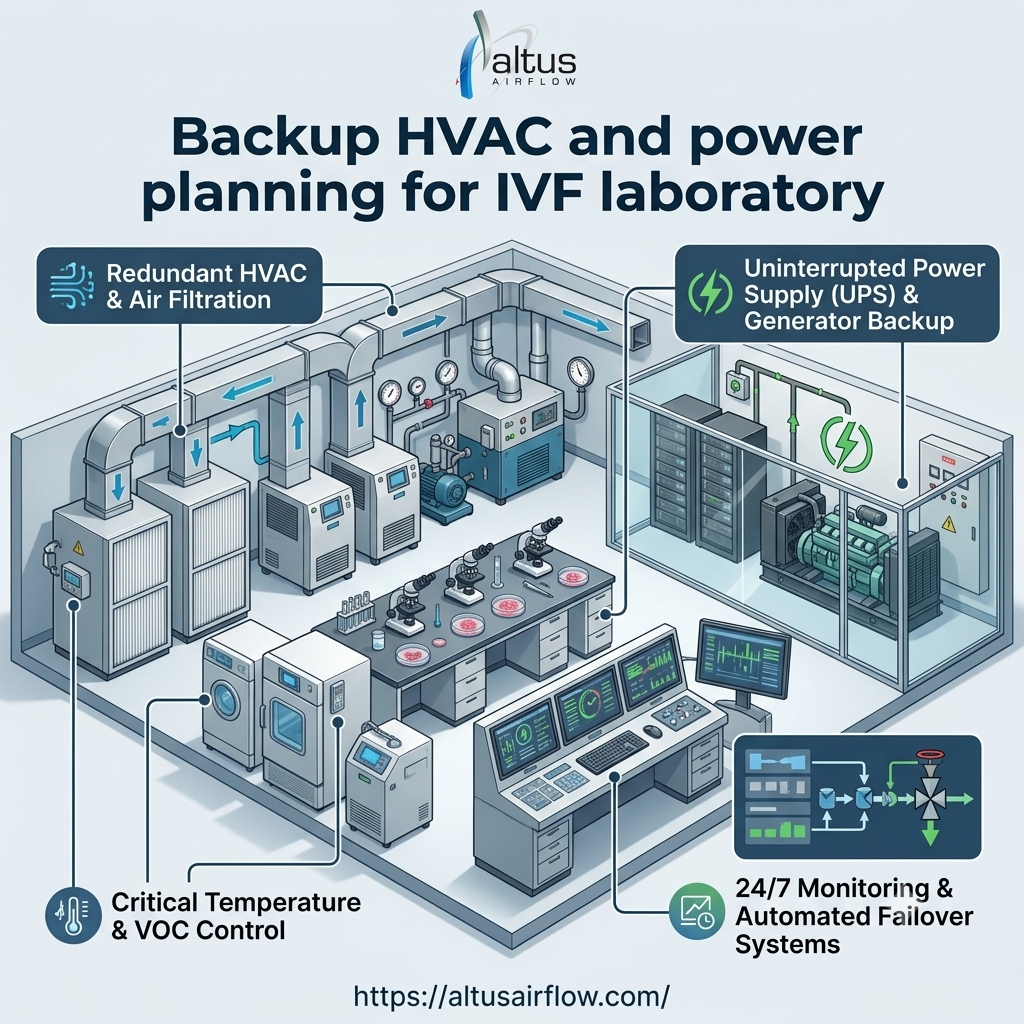
HVAC Redundancy and Reliability
IVF laboratory operations may depend on continuous environmental stability. HVAC failures can therefore present operational risks.
Depending on the facility's risk assessment, the design may consider:
- Standby HVAC capacity
- Redundant critical components
- Backup power
- Emergency controls
- Alarm systems
- Automatic restart
- Spare equipment capacity
The degree of redundancy should be determined according to the laboratory's critical systems, risk assessment, operational requirements, and budget.
Backup Power Integration
HVAC systems supporting critical laboratory environments should be coordinated with electrical and backup-power planning.
Important systems may include:
- Air-handling units
- Control systems
- Environmental monitoring
- Critical refrigeration
- Incubator systems
- Alarm systems
UPS systems, generators, or other backup arrangements can be considered according to the facility's emergency-power strategy.
Environmental Monitoring
Modern IVF laboratories can incorporate continuous environmental monitoring.
Parameters may include:
- Temperature
- Relative humidity
- Differential pressure
- Airflow
- Particle levels where required
- HVAC operating status
- Alarm conditions
Monitoring systems can provide historical data and alerts, allowing laboratory teams to identify environmental deviations more quickly.
Building Management System Integration
HVAC systems can be connected to a Building Management System or dedicated facility-management platform where appropriate.
Integration can allow monitoring of:
- Temperature
- Humidity
- Pressure
- HVAC equipment status
- Filter condition
- Alarms
- Energy consumption
Centralized monitoring can make facility management more efficient and provide useful information for maintenance and troubleshooting.
Cleanroom and Modular Construction Coordination
In many IVF projects, HVAC is integrated with modular cleanroom construction.
The HVAC designer must coordinate with:
- Modular wall panels
- Ceiling systems
- HEPA filter housings
- Lighting
- Service panels
- Doors
- Electrical systems
- Medical and laboratory utilities
Early coordination reduces clashes during installation and helps maintain the integrity of the controlled environment.
HVAC Ductwork Planning
Ductwork design influences airflow distribution, pressure losses, maintenance, and energy efficiency.
Planning should consider:
- Duct sizing
- Air velocity
- Pressure drop
- Insulation
- Cleanability
- Access panels
- Sealing
- Ceiling space
- Filter locations
Properly coordinated ductwork can improve system performance and reduce installation problems.
Contamination Control During Construction
HVAC systems should be protected during laboratory construction. Dust, debris, and construction contaminants can enter ducts and equipment if appropriate controls are not implemented.
Construction planning may include:
- Temporary sealing of duct openings
- Protection of AHUs
- Controlled material handling
- Dust containment
- Cleaning of ductwork where required
- Pre-commissioning cleaning
- Final environmental testing
The laboratory should be thoroughly cleaned and tested before operational use.
Testing and Commissioning
HVAC performance should be verified after installation.
Depending on the project, testing may include:
- Airflow measurements
- Air velocity measurements
- Temperature testing
- Humidity testing
- Pressure differential testing
- HEPA filter integrity testing
- Particle measurements
- Airflow visualization
- Control-system testing
Commissioning confirms that the system operates according to approved design parameters.
Preventive HVAC Maintenance
Maintaining the HVAC system is essential for long-term environmental stability.
Maintenance activities may include:
- Filter inspection
- HEPA filter replacement when required
- AHU servicing
- Fan and motor inspection
- Sensor calibration
- Coil cleaning
- Duct inspection
- Airflow balancing
- Pressure verification
A documented preventive-maintenance schedule can help identify problems before they affect laboratory operations.
Energy-Efficient HVAC Planning
IVF laboratories may require continuous HVAC operation, making energy efficiency an important consideration.
Energy-saving strategies can include:
- Efficient fans
- Variable-speed drives
- Proper duct sizing
- High-efficiency equipment
- Optimized cooling capacity
- Appropriate insulation
- Smart controls
- Demand-based strategies where compatible with laboratory requirements
Energy efficiency should never compromise required environmental stability.
Future Expansion
A good HVAC design should consider future laboratory expansion. Fertility clinics may add equipment, increase capacity, or introduce additional procedures.
Future-ready planning can include:
- Additional AHU capacity
- Spare electrical capacity
- Expandable ductwork
- Additional monitoring points
- Modular filtration
- Flexible zoning
- Space for future equipment
Planning for expansion can reduce the cost and disruption associated with future modifications.
Common HVAC Planning Mistakes
Several mistakes can reduce HVAC performance in an IVF laboratory.
These include:
- Designing HVAC after finalizing the layout
- Ignoring equipment heat loads
- Insufficient filtration planning
- Poor airflow distribution
- Inadequate pressure monitoring
- Ignoring VOC sources
- Insufficient backup planning
- Poor duct coordination
- Lack of commissioning
- Neglecting preventive maintenance
Early multidisciplinary coordination can help prevent these problems.
Choosing an IVF Laboratory Design Partner
When selecting a design provider, fertility clinics should evaluate:
- IVF laboratory experience
- HVAC engineering expertise
- Cleanroom knowledge
- HEPA filtration experience
- Equipment integration capability
- Environmental monitoring
- Testing and commissioning
- Documentation
- Maintenance support
- Future expansion planning
A qualified provider should be able to coordinate architectural, HVAC, electrical, laboratory, and operational requirements within one coherent design approach.
Conclusion
HVAC planning is incorporated into IVF Lab Design In India through coordinated assessment of laboratory zoning, temperature, humidity, filtration, airflow, pressure relationships, fresh-air requirements, VOC control, equipment heat loads, environmental monitoring, backup systems, testing, commissioning, and preventive maintenance. HVAC should be planned alongside cleanroom construction, equipment placement, electrical systems, workflow, and contamination-control measures rather than treated as an independent service. A well-engineered system can help maintain stable and controlled laboratory conditions while supporting efficient embryology operations and long-term facility management. For specialized IVF laboratory planning and integrated healthcare infrastructure, Altus Airflow provides solutions focused on controlled environments, engineering coordination, and future-ready laboratory requirements.
Frequently Asked Questions
1. Why is HVAC important in IVF Lab Design In India?
HVAC is important in IVF Lab Design In India because it helps control temperature, humidity, filtration, airflow, pressure, and air quality, supporting stable environmental conditions for sensitive IVF laboratory processes.
2. How is temperature controlled in IVF Lab Design In India?
In IVF Lab Design In India, temperature control is planned according to laboratory requirements, equipment heat loads, occupancy, external conditions, HVAC capacity, and the environmental needs of sensitive laboratory processes.
3. Does IVF Lab Design In India include HEPA filtration?
Yes, IVF Lab Design In India can incorporate HEPA filtration where required by the laboratory's cleanliness objectives, risk assessment, HVAC strategy, and applicable project requirements.
4. How is humidity managed in IVF Lab Design In India?
Humidity management in IVF Lab Design In India may involve appropriate cooling, dehumidification, humidification where necessary, fresh-air treatment, sensors, and automated HVAC controls.
5. Is VOC control considered in IVF Lab Design In India?
Yes, VOC control can be considered in IVF Lab Design In India through suitable HVAC filtration and ventilation strategies combined with low-emission materials, controlled chemical use, and appropriate laboratory practices.
Read Our Previous Blog------>What standards and regulations should an IVF Lab Design Company follow?
 Italiano
 English
 Arabic
 French
 Spanish
 Portuguese
 Deutsch
 Turkish
 Dutch
 Russian
 Romaian
 Portuguese (Brazil)
 Greek